















Product information
ROX Factor XIa
Transferred from the original PDF and compared with it. The original document remains authoritative.
Art No. 110050 For In Vitro Research Use - Not for Diagnostic Use 2 x 50 tests / kit
1 INTENDED USE
Quantitative activity determination of contaminating Factor XIa (FXIa) in enriched and highly purified protein preparations. Not intended for analysis of plasma.
2 BIOCHEMISTRY
Factor XI (FXI) is a dimeric protein of 160 kDa, which is activated to FXIa by FXIIa or by thrombin. Activation of FXI may occur inadvertently during protein purifications and FXIa can be a contaminant in intermediate or final products.
3 MEASUREMENT PRINCIPLE
FXIa functional activity is determined in a chromogenic method, in which human FIX is activated to FIXa in the presence of calcium ions. FIXa then activates human FX in the presence of human FVIII, calcium ions and phospholipid. The amount of FXa is determined from the hydrolysis of a chromogenic FXa substrate and is related to the FXIa activity of the sample. The concentration of functionally active FXIa is assigned vs. a FXIa Calibrator and expressed in Units.
4 KIT COMPOSITION
Reagent 1 (2 vials) - 1110
Reagent 1 contains lyophilized human Factor IX, human Factor VIII and calcium chloride. Each vial is sufficient for 50 tests.
Reagent 2 (2 vials) - 1120
Reagent 2 contains lyophilized human Factor X, bovine thrombin, calcium chloride and phospholipids. Each vial is sufficient for 50 tests.
FXa Substrate, 6 mL (1 vial) - 9080
Liquid solution of chromogenic FXa substrate (Z-D-Arg-Gly-Arg-pNA), 2.5 mmol/L, containing a thrombin inhibitor. Ready to use.
Diluent Buffer, Stock Solution, 20 mL (1 vial) - 1150
Liquid stock solution of diluent buffer.
5 PRECAUTIONS AND WARNINGS
CAUTION: Each donor unit used in the preparation of Reagent 1 and Reagent 2 has been tested by FDA approved methods for the presence of Hepatitis B surface antigen and antibodies to HIV 1 and 2 and Hepatitis C and found to be negative. However, since no test can completely rule out the presence of these blood borne diseases, the handling and disposal of this human source reagent should be made with care.
- Avoid contact with skin and eye.
- Do not empty into drains.
- Wear suitable protective clothing.
6 PREPARATION
Reagent 1 (1110)
Reconstitute with 3.0 mL water. Allow to stand for 5 min at 20-25°C with intermittent gentle mixing for complete reconstitution.
Reagent 2 (1120)
Reconstitute with 3.0 mL water. Allow to stand for 5 min at 20-25°C with intermittent gentle mixing for complete reconstitution.
FXa Substrate, 6 mL (9080)
Ready to use.
Diluent Buffer, Stock Solution, 20 mL (1150)
Before use, dilute 1 + 9 with water to obtain a 0.05 mol/L Tris-HCl buffer working solution, pH 7.9 with 1% bovine serum albumin.
Note: All reconstitutions and dilutions should be made with water of a quality of at least NCCLS Type II water.
7 STORAGE AND STABILITY
The sealed reagents are stable at 2-8°C until the Expiry Date printed on the label. Be careful to avoid contamination of the reagents by microorganisms.
- Reconstituted Reagent 1 and Reagent 2 : Stability after reconstitution is 8 hours at 2-8°C and 2 hours at 37°C.
- Chromogenic FXa substrate: Opened vial is stable for 1 month at 2-8°C.
- Diluent Buffer, Stock Solution: Opened vial is stable for 1 month at 2-8°C.
- Buffer working solution should be used the same day as prepared.
8 CALIBRATOR AND CONTROL
FXIa Calibrator (Art No. 1199) and FXIa Control (Art No. 1188) are available from Rossix in packages of 10 vials each. Both products are assigned in milliUnits and calibrated against NIBSC reference reagent for Activated Blood Coagulation Factor XI (FXIa), Human, 11/236.
9 MATERIALS REQUIRED BUT NOT PROVIDED
- Deionized water, filtered through 0.22 µm or NCCLS Type II water or higher quality
- Citric acid, 2% (for end-point method)
- Calibrated pipettes
- Photometer, 405 nm (and 490 nm for end-point method)
- Heat incubator 37°C
- Plastic test tubes
- Stop-watch
- Vortex mixer
10 SYMBOLS USED
| Symbol | Meaning |
|---|---|
| REF | Catalog number |
| LOT | Batch code |
| Hourglass symbol | Use by |
| Thermometer symbol | Temperature limitation |
| Open book symbol with "i" | Consult instruction for use |
| Biohazard symbol | Biological risks |
| Factory symbol | Manufacturer |
11 METHOD
11.1 Standard dilutions
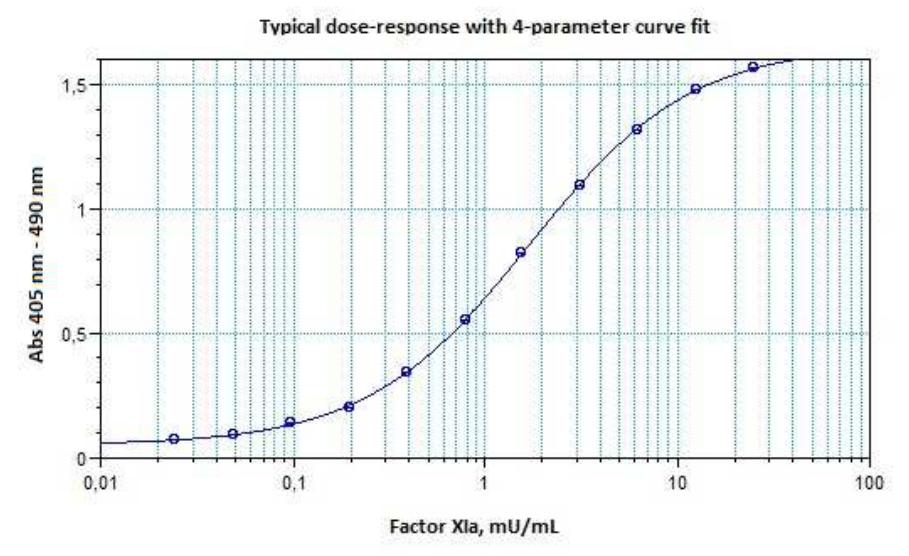
A standard curve should be included in each run. Prepare standard dilutions in Diluent Buffer working solution to obtain standards in the range 0.04–10 mU/mL. Prepare at least five different standard dilutions. All dilutions should be prepared in plastic test tubes.
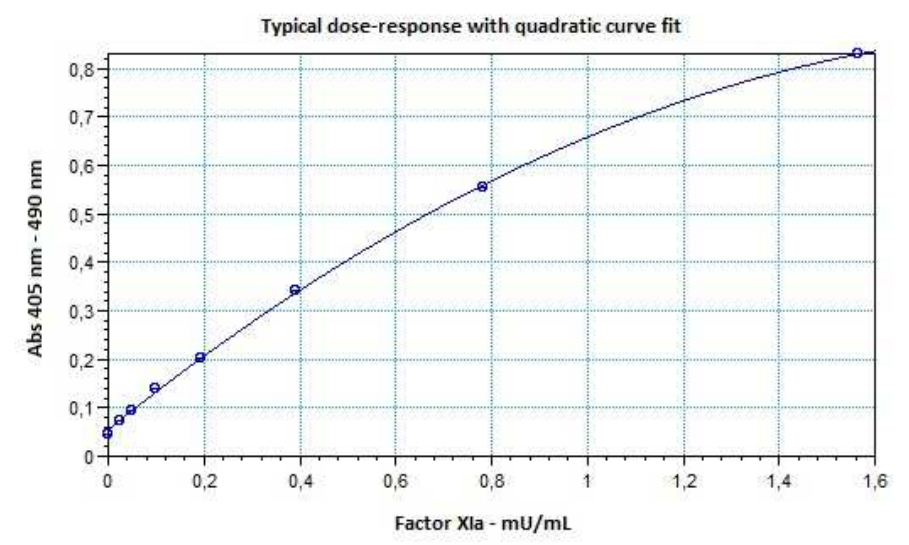
The standard curve could be limited to the range 0.04 – 1.4 mU/mL. When using this restricted range, a quadratic curve fit could be used.
Example: Predilute the reconstituted FXIa Calibrator to a potency of 10 mU/mL and prepare further dilutions according to the table below. It is recommended to prepare independent predilutions for each standard.
| FXIa Standard, mU/mL | Volume of FXIa Standard | Volume of FXIa Diluent Buffer working solution |
|---|---|---|
| 10 | 1000 µL of 10 mU/mL FXIa | - |
| 4 | 200 µL of 10 mU/mL FXIa | + 300 µL |
| 1.4 | 100 µL of 10 mU/mL FXIa | + 614 µL |
| 0,4 | 50 µL of 10 mU/mL FXIa | + 1200 µL |
| 0,1 | 20 µL of 10 mU/mL FXIa | +1980 µL |
| 0,04 | 200 µL of 0.1 mU/mL FXIa | + 300 µL |
| 0 | 500 µL |
NOTE: The above table is an example only and is based on a FXIa calibrator level with an activity of 10 mU/mL.
11.2 Sample dilution
Dilute the sample 1:40 in Diluent Buffer working solution. All dilutions should be prepared in plastic test tubes.
To obtain an even higher sensitivity, a lower sample dilution (1:10 - 1:40) might be used. It is then necessary to check for any matrix interference by comparing assigned FXIa activities at several different dilutions.
In case of low or no measured FXIa acticity, matrix interference may suitably be investigated by spiking the sample with e.g. 20 mU/mL FXIa and determine the recovery in the sample when assayed at several different dilutions, starting at a 1:10 dilution. This will establish the minimal dilution required to eliminate matrix interference.
11.3 Assay
| Step | Volume |
|---|---|
| Sample / Standard dilution (20-25°C) | 50 µL |
| Heating 3-4 min, 37°C | |
| Reagent 1 (37°C) | 50 µL |
| FIX activation 4 min, 37°C | |
| Reagent 2 (37°C) | 50 µL |
| FIX and FX activation 2 min, 37°C | |
| FXa Substrate (37°C) | 50 µL |
| Kinetic method: Read ΔA405/min at 37°C End-point method: Incubate at 37°C for 2 min | |
| Citric Acid, 2% (Endpoint method only) | 50 µL |
Kinetic method: Read the absorbance change at 405 nm.
End-point method: Stop the reaction with 2% citric acid after 2 min hydrolysis at 37°C. Read the absorbance at 405 nm, using 490 nm as reference wavelength. Absorbance readings should be made within 2 hours after termination of the substrate hydrolysis.
12 CALCULATION
- Plot absorbance change/minute (ΔA405/min) or absorbance (A405-490) vs. log FXIa activity. Use a 4-parameter curve fit, y = ((A-D)/(1 + (x/C)^B))+D. Alternatively, when using a standard range up to 1.4 mU/mL: Plot absorbance change/minute (ΔA405/min) or absorbance (A405-490) vs. FXIa activity Use a quadratic curve fit, y = A + Bx + Cx²
- The FXIa activity of the tested sample is obtained directly from the calibration curve. Correct the obtained value with the dilution factor used.
- If several sample dilutions are used, adjust for each dilution with the appropriate dilution factor.
- Express the FXIa result as U/mL.
13 PERFORMANCE CHARACTERISTICS
| Parameter | Value |
|---|---|
| Sensitivity: | The assay allows detection of about 0.03 mU/mL FXIa activity, which translates to detection of 1.2 mU/mL in the neat sample when using a sample dilution of 1:40. |
| Imprecision: | Intra-assay CV < 4% at 1.6 mU/mL FXIa < 4% at 0.08 mU/mL FXIa Inter-assay CV < 3% at 1.6 mU/mL FXIa < 5.5% at 0.08 mU/mL FXIa |
Imprecision data were obtained from 6 assay series using 6 replicates of each concentration.
14 INTERFERENCE
Assuming a recommended sample dilution of 1:40, Factor XIa results are not affected by the following levels in the neat sample of the analytes stated below:
| Analyte | Level |
|---|---|
| Ethanol | ≤ 50% |
| NaCl | ≤ 1 M |
| Factor XI zymogen: | No effect at 0.2 µM |
| Human kallikrein: | ≤ 50 nM |
| Factor II | ≤ 0.2 µM |
| Factor X: | No effect at 0.5 µM |
| Factor Xa: | < 1.2 nM |
| Factor IXa: | ≤ 1 mIU/mL |
No synergistic effects were observed in mixtures of human kallikrein in the absence or presence of human FXI and/or human FXIa.
15 CONTACT INFORMATION
Rossix AB Taljegardsgatan 3B SE-431 53 Molndal Sweden
Phone: +46 31 706 8965 Fax : +46 31 706 8966 info@rossix.com www.rossix.com
16 REVISION DATE
Last revision date: September 17, 2012
17 REFERENCES
- Meijers JCM, Tekelenburg WLH, Bouma BN, Bertina RM, Rosendaal FR. High levels of coagulation factor XI as a risk factor for venous thrombosis. N Engl J Med 342, 696-701 (2000).
- Doggen CJM, Rosendaal FR, Meijers JCM. Levels of intrinsic coagulation factors and the risk of myocardial infarction among men: Opposite and synergistic effects of factors XI and XII. Blood 108, 4045-4051 (2006).
- Suri MFK, Yamagishi K, Aleksic N, Hannan PJ, Folsom AR. Novel hemostatic factor levels and risk of ischemic stroke: the Atherosclerosis Risk in Communities (ARIC) Study. Cerebrovasc Dis 29, 497-502 (2010).
- Woodruff RK, Grigg AP, Firkin FC, Smith IL. Fatal thrombotic events during treatment of autoimmmune thrombocytopenia with intravenous immunoglobulin in elderly patients. Lancet 2, 217-218 (1986).
- Caress JB, Hobson-Webb L, Passmore LV. Case-control study of thromboembolic events associated with IV immunoglobulin. J Neurol 256, 339-342 (2009).
- Foster R, Suri A, Filate W, et al. Use of intravenous immune globulin in the ICU: a retrospective review of prescribing practices and patient outcomes. Transfus Med 20, 403-408 (2010).
- Etscheid M, Breitner-Ruddock S, Gross S, Hunfeld A, Seitz R, Dodt J. Identification of kallikrein and FXIa as impurities in therapeutic immunoglobulins: implications for the safety and control of intravenous blood products. Vox Sanguinis 102, 40-46 (2012).
- Lindquist PA, Fujikawa K, Davie EW. Activation of bovine Factor IX (Christmas Factor) by Factor XIa (Activated Plasma Thromboplastin Antecedent) and a protease from Russell´s Viper Venom. J Biol Chem 253, 1902-1909 (1978).
- Tans G, Janssen-Claessen T, van Dieijen G, Hemker HC, Rosing J. Activation of Factor IX by Factor XIa – a spectrophotometric assay for Factor IX in human plasma. Thromb Haemost 48, 127-132 (1982).
- Walsh PN, Bradford H, Sinha D, Piperno JR, Tuszynski GP. Kinetics of the Factor XIa catalyzed activation of human blood coagulation Factor IX. J Clin Invest 73, 1392-1399 (1984).