















Product information
Factor IXa
Transferred from the original PDF and compared with it. The original document remains authoritative.
Art No. 950030 For laboratory use only - Not for diagnostic use 100 tests / kit
1 Intended use
For quantitative determination of human Factor IXa (FIXa) contamination in human Factor IX (FIX) concentrates.
2 Measurement principle
FIXa activity in FIX concentrates is determined in a chromogenic method, in which human FX is activated by contaminating human FIXa in the FIX concentrate in the presence of FVIII, thrombin, calcium ions and phospholipid. The amount of generated human FXa is determined from the hydrolysis of a chromogenic FXa substrate. The sample FIXa activity is determined by the slope ratio model in which the potency of the sample is calculated vs. a FIXa standard with potency expressed in International Units (IU).
3 Kit Composition
Reagent 1 (2 vials)
Reagent 1 contains lyophilized Factor VIII and human FX. Reconstitute with 2.8 mL water. Allow to stand for 5 min at 20-25°C with intermittent gentle mixing for complete reconstitution.
Reagent 2 (2 vials)
Reagent 2 contains lyophilized thrombin, calcium chloride and phospholipids. Reconstitute with 4.0 mL water. Allow to stand for 5 min at 20-25°C with intermittent gentle mixing for complete reconstitution.
FXa Substrate, 5 mL (1 vial)
Liquid solution of chromogenic FXa substrate (Z-D-Arg-Gly-Arg-pNA), 2.5 mmol/L, containing a thrombin inhibitor. Ready to use.
FIXa Diluent Buffer, Stock Solution, 20 mL (1 vial)
Liquid stock solution of diluent buffer. Before use, dilute 1 + 9 with water to obtain a 0.05 mol/L Tris-HCl buffer working solution, pH 7.5 with 1% bovine serum albumin.
Note: All reconstitutions and dilutions should be made with water of a quality of at least NCCLS Type II water.
4 Calibrator and control
FIXa Calibrator (Art No. 9599) and FIXa Control (Art No. 9588) are available from Rossix. Both products are potency assigned vs a WHO International Standard for FIXa and are provided in packages of 10 vials each.
5 Materials required but not provided
- Deionized water, filtered through 0.22 µm or NCCLS Type II water or higher quality.
- Citric acid, 2% (for end-point method).
- Calibrated pipettes
- Photometer, 405 nm (and 490 nm for end-point method)
- Heat incubator 37°C
- Plastic test tubes
- Stop-watch
- Vortex mixer
For microplate assay, make sure to use microplates suitable for hemostasis assays involving phospholipids and FVIII. Always work in a standardized manner in order to obtain a high accuracy.
6 Precaution and warnings
CAUTION: Each donor unit used in the preparation of human source Reagent 1 and 2 has been tested by FDA approved methods for the presence of Hepatitis B surface antigen and antibodies to HIV 1 and 2 and Hepatitis C and found to be negative. However, since no test can completely rule out the presence of these blood borne diseases, the handling and disposal of this human source reagent should be made with care.
- Avoid contact with skin and eye.
- Do not empty into drains.
- Wear suitable protective clothing.
7 Storage and stability
The sealed reagents are stable at 2-8°C until the Expiry Date printed on the label. Be careful to avoid contamination of the reagents by microorganisms.
- Reconstituted Reagent 1: Stability after reconstitution: 48 hours at 2-8°C.
- Reconstituted Reagent 2: Stability after reconstitution: 48 hours at 2-8°C.
- Chromogenic FXa substrate: Opened vial is stable for 1 month at 2-8°C.
- FIXa Diluent Buffer, Stock Solution: Opened vial is stable for 1 month at 2-8°C.
- Diluent Buffer working solution should be used the same day as prepared.
8 Method
8.1 Standard dilutions
A standard curve should be included in each run. Prepare standard dilutions in FIXa Diluent Buffer working solution to obtain standards in the range 0.02–0.8 mIU/mL. Prepare at least five different standard dilutions. All dilutions should be prepared in plastic test tubes.
Example: Predilute the FIXa Calibrator to a potency of 1.0 mIU/mL and prepare further dilutions according to the table below. It is recommended to prepare independent predilutions for each standard.
| FIXa Standard, mIU/ml | Volume of FIXa Standard | Volume of FIXa Diluent Buffer working solution |
|---|---|---|
| 0.8 (100%) | 300 µL of 1.0 mIU/mL FIXa | + 75 µL |
| 0.56 (70%) | 300 µL of 1.0 mIU/mL FIXa | + 236 µL |
| 0.32 (40%) | 300 µL of 1.0 mIU/mL FIXa | + 638 µL |
| 0.08 (10%) | 100 µL of 1.0 mIU/mL FIXa | + 1150 µL |
| 0.02 (2.5%) | 50 µL of 1.0 mIU/mL FIXa | +2450 µL |
| 0 (0%) | 500 µL |
NOTE: The above table is an example only and is based on a FIXa calibrator with an activity of 1.0 mIU/mL. The volumes should be adjusted for the potency of the calibrator being used.
8.2 Sample dilution
It is recommended to analyse the FIX concentrate sample at several different dilutions, starting at a FIX potency of 1.0 IU/mL, to establish the minimal dilution required to obtain a linear dose-response. For subsequent analysis only use those sample dilutions that fulfil the requirement of a linear dose-response. The FIXa activity assignment of the tested FIX concentrate should then be determined according to the slope ratio model (see 8.5 Calculations). All dilutions should be prepared in plastic test tubes with FIXa Diluent Buffer working solution as diluent.
Example: Assume a linear dose-response is obtained from a FIX potency of 0.5 IU/mL. Set 0.5 IU/mL = 100%
| Sample | Volume of FIX Sample | Volume of FIXa Diluent Buffer working solution |
|---|---|---|
| 100% | 1000 µL of 0.5 IU/mL | 0 µL |
| 70% | 300 µL of 100% sample | + 129 µL |
| 40% | 300 µL of 100% sample | + 450 µL |
| 10% | 300 µL of 100% sample | + 2700 µL |
NOTE: The above is an example only.
8.3 Assay
| Step | Volume |
|---|---|
| Sample / Standard dilution | 50 µL |
| Reagent 1 | 50 µL |
| Incubation 2-4 min, 37°C | |
| Reagent 2 (37°C) | 75 µL |
| Activation 4 min, 37°C | |
| FXa Substrate (37°C) | 50 µL |
| Kinetic reading or hydrolysis 20 min, 37°C | |
| Citric acid, 2% (Endpoint method only) | 50 µL |
Kinetic reading: Read the absorbance at 405 nm.
End-point method: Read the absorbance at 405 nm, using 490 nm as reference wavelength. Absorbance readings should be made within 4 hours.
8.4 Typical Standard Curve
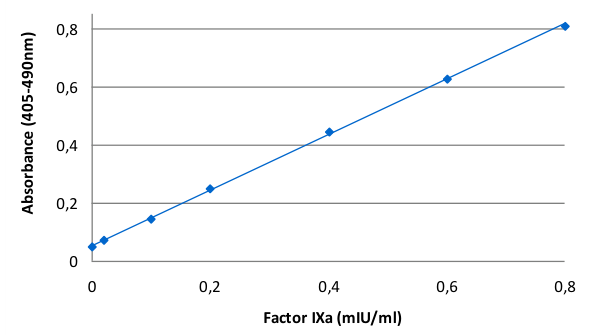
The above graph is an example only. A standard curve should be included in each run.
8.5 Calculations
8.5.1 Slope ratio model
The European Pharmacopoeia recommends the use of the slope ratio or parallel line model.¹
- Plot absorbance change / min or absorbance vs. FIXa activity (mIU/mL or %) in a Lin-Lin graph
- Assign the sample FIXa activity from the standard curve using the slope ratio model.
- Adjust for the dilution and express the results as mIU FIXa / ml or mIU FIXa / IU FIX.
8.5.2 Potency assignment directly from the calibration curve.
As an alternative to the slope ratio model, the Factor IXa activity in a dilution of the tested sample can be directly obtained from the calibration curve. The result should then be multiplied by the dilution factor used.
NOTE: If the direct method is used it is important to verify that the analyzed sample is tested at a dilution which is within a dilution range that gives a proper linear dose-response. If not, there is a risk of underestimation of the FIXa activity in the sample.
8.5.3 Example of a slope ratio calculation
Below is an example of the basic concept behind the slope ratio model in the context of the Rox FIX-A kit method. For details regarding a complete statistical analysis, please refer to the European Pharmacopoeia¹.
In this example the FIXa standard 0.8 mIU/ml is set as 100% and the sample dilution 0.5 IU FIX /ml is set as 100%
- Plot the responses vs dose %. It is assumed that both the FIXa calibrator and the sample is assayed at the levels 10%, 25%, 50%, 75% and 100%.
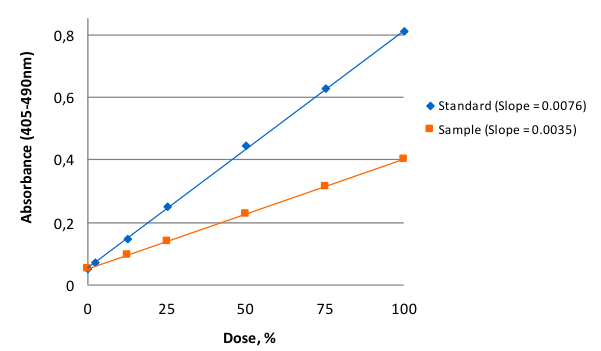
- Compare the slopes of the standard curve and the sample. In this example the slope of the standard curve is 0.0076 and 0.0035 for the sample curve, resulting in a slope ratio of 0.46 (0.0035/0.0076).
- Calculate the FIXa activity of the sample and relate it to the FIX potency.
| Stability / note | Slope | Slope Ratio | FIXa activity | FIXa / FIX |
|---|---|---|---|---|
| Standard | 0.0076 | 100% = 0.8 mIU FIXa /ml | ||
| Sample | 0.0035 | 0.46 | 0.46 x 0.8 = 0.368 mIU FIXa /ml | 0.368 /0.5 = 0.736 mIU FIXa / IU FIX |
9 Contact Information
Rossix Taljegardsgatan 3B SE-431 53 Molndal Sweden
Phone: +46 31 706 8965 Fax: +46 31 706 8966 info@rossix.com www.rossix.com
10 References
- 6ᵗʰ Edition of the European Pharmacopoeia, General Chapter 5.3 Statistical analysis of results of biological assays and tests.
- Gray E, Tubbs J, Thomas S et al. Measurement of activated Factor IX in Factor IX concentrates: Correlation with In Vivo thrombogenicity. Thromb Haemost 1995; 73 (4): 657-9.
- Pickering W M, Gray E. The effect of activated Factor IX on the Factor IX coagulant and NAPTT activity of high-purity Factor IX concentrates. J Thromb Haemost 2007; 5, Supplement 2: P-T-156.